Stinging insect activity in the Bakken oil patch spikes between late June and September when ambient temperatures routinely exceed 85 degrees Fahrenheit. In areas like Harvest Hills and Fox Run, western paper wasps…
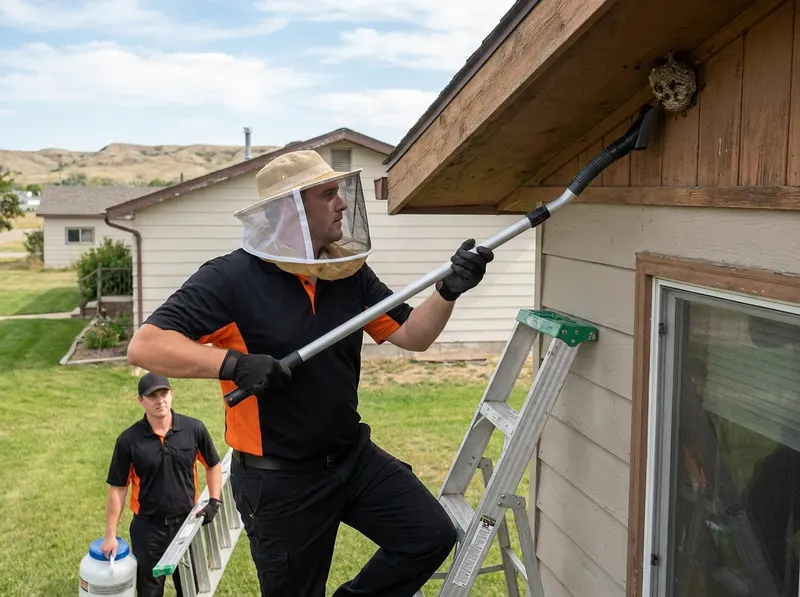
Stinging insect activity in the Bakken oil patch spikes between late June and September when ambient temperatures routinely exceed 85 degrees Fahrenheit. In areas like Harvest Hills and Fox Run, western paper wasps establish open-comb paper nests under vinyl soffits, horizontal window headers, and porch decks. Industrial worker housing at Bakken Cabins and properties along Sand Creek frequently experience subterranean yellowjacket burrows along perimeter grade borders, where machinery vibrations trigger aggressive swarm defenses. Unmonitored nests near entryways present immediate hazards to oil-field personnel, tenants, and pets, particularly during late August when natural floral nectar drops and colonies enter their predatory worker phase.
Mechanical knockdowns without residual insecticidal dusting create high risks of immediate re-nesting on exposed framing. Professional removal employs targeted pyrethroid contact aerosols followed by micro-encapsulated dust injection directly into wall cavities or eave joints. This two-phase treatment neutralizes foraging workers returning to the site over the following 24 hours. For commercial modular units and multi-family residential structures in Eagle Crest and The Timbers, localized exterior treatments prevent defensive hornets from penetrating degraded caulking seams and entering conditioned interior rooms. Interior pets remain isolated from exterior aerosol zones for 60 to 90 minutes post-treatment until chemical carriers dry completely.
Physical extraction occurs under protective gear, separating the primary core envelope from the framing substrate. 1. The exterior nesting point undergoes structural inspection to verify species identity and determine void depth. 2. Insecticidal application neutralizes active comb inhabitants within 15 minutes. 3. Technicians physically cut down and bag the physical comb structure to eliminate pheromone trails. 4. Wall voids and wood fascia receive micro-encapsulated barrier dust. 5. Any opened inspection gaps receive temporary sealants to prevent secondary cluster colonization.
Every job gets a firm, written price after a free on-site visit.
Tell us about your seasonal stinging insect removal job in Williston and we'll send a clear, written quote, usually the same day.
 Nolvexa Pest Solutions